If a Powerful EMP Strikes America,
the Blackout Could Be Only the Beginning
The electronics you've been counting on to help your family survive could be damaged before you even get a chance to use them. Here's a simple precaution you can take before it's too late
A powerful EMP attack could knock out large parts of America's electrical grid.
Water pumping stations could stop working.
Gas stations could lose the ability to pump fuel.
Grocery stores could empty out as refrigeration, transportation, and supply networks begin breaking down.
Hospitals could find themselves struggling to care for patients while relying on emergency generators and limited supplies.
And millions of Americans could suddenly find themselves without the phones, Internet connections, ATMs, and other electronic services they rely on every day.
The consequences could be devastating.
Unlike a local storm, a major EMP could disrupt critical infrastructure across an enormous area at the same time.
There may be no unaffected neighboring state ready to send everything that's needed.
And the longer the power stays out, the harder life could become for ordinary families.
But there's something else you should know.
An EMP doesn't just threaten the electricity coming into your home. It can also threaten the electronic equipment you've been counting on to survive without it.
Your emergency radio.
Your spare phone.
Your laptop containing downloaded maps and survival guides.
The backup electronics you've carefully put aside for a crisis.
Even if they're switched off and unplugged, they may still be vulnerable to a sufficiently powerful electromagnetic pulse.
And if they're damaged, you might have no way to replace them.
Think about that for a moment.
You could have spent years stocking food, water, batteries, and medical supplies.
You could have done everything possible to prepare your family for a prolonged blackout.
Yet the very electronics you were saving for that emergency might fail before you ever have a chance to use them.
That's a risk I believe deserves your attention.
And today, I'd like to show you a practical way to address it.
In the next few minutes, I'm going to explain:
- Why a major EMP could be far more disruptive than an ordinary power outage, and what the Starfish Prime nuclear test taught us about this threat.
- Which three types of portable electronics I believe deserve priority protection before an emergency.
- How a specially designed Faraday bag can help shield those devices without requiring complicated equipment or installations.
- And why you may want two separate protected electronics kits rather than keeping everything together.
I'll also show you a real demonstration of a 15-liter EMP Vault Faraday Blackout Bag that has enough room for far more than a single phone.
But first, a quick word about why I consider this so important.
Who I Am and Why I Believe
You Should Take This Seriously
My name is Alec Deacon.
If you've been following Survivopedia or have read my preparedness guides, including Backyard Liberty and Blackout USA, you're probably familiar with my work.
I'm a co-founder of Survivopedia, a husband, a father, and a Christian.
And I've spent years writing about how ordinary Americans can become more self-reliant and better prepared for difficult times.
I believe we have a responsibility to look after our families.
And while I hope we can always rely on functioning hospitals, grocery stores, utilities, and emergency services, I don't believe we should make those systems our only plan.
We've all seen how quickly a disaster can overwhelm a community.
Sometimes help arrives fast.
Sometimes it doesn't.
That's why I encourage people to put aside useful supplies, learn practical skills, and make preparations while they still have the opportunity.
But there's one threat I've been particularly concerned about.
Because it could disrupt several of the systems we depend on all at once.
And the strange thing is, we've known about this danger for more than sixty years.
The Nuclear Test That Revealed
America's Electronic Vulnerability
In July 1962, the United States detonated a nuclear device high above the Pacific Ocean.
The operation was called Starfish Prime.
The explosion took place roughly 250 miles above Earth.
Yet its electromagnetic effects reached the Hawaiian Islands, far from the detonation.
Streetlights went dark.
Electrical equipment was disturbed.
Communications infrastructure experienced disruption.
The nuclear test also produced radiation effects that damaged satellites in orbit.
And remember, that was 1962.
American households didn't have computers sitting on every desk.
Nobody carried a smartphone.
Families weren't storing important records on hard drives or navigating with GPS.
Today, virtually everything depends on electronics.
Our communications networks.
Our vehicles.
Our banking systems.
Medical equipment.
Water and electrical infrastructure.
Even many of the tools people purchase specifically to prepare for emergencies.
A high-altitude nuclear EMP can produce several distinct electromagnetic effects, some particularly dangerous to long electrical conductors and connected infrastructure.
The exact damage from a future event would depend on many factors.
But one thing is clear: a sufficiently powerful EMP could create serious disruptions far beyond the location of the explosion itself.
And that could make recovery extremely difficult.
Why an EMP Blackout Could Be Different
From Anything You've Experienced
When a hurricane knocks out electricity, utility crews can often bring equipment and supplies from unaffected regions.
When flooding destroys roads, assistance can arrive from outside the disaster area.
And when a town suffers a major emergency, hospitals and emergency services in nearby communities can help.
Now consider what could happen if a severe electromagnetic event damaged electrical and communications infrastructure across several states at once.
There might be widespread equipment failures.
Repair teams could struggle to obtain replacement components.
Fuel distribution could be disrupted.
Communication between emergency agencies could become difficult.
And restoring power might involve more than simply repairing a few broken lines.
In some areas, it could require replacing specialized equipment that's expensive and difficult to manufacture.
Meanwhile, families would still need food, drinking water, medicine, information, and some way to communicate.
This is why I've always believed it's worth preparing for more than a three-day inconvenience.
Because if the systems around you stop functioning for an extended period, the supplies and equipment you've already stored could become extraordinarily valuable.
And that brings me to something many people overlook.
Three Things I'd Want Protected Before an EMP
If you're preparing for a serious grid-down emergency, there are three types of portable electronics I would pay particular attention to.
1. Your Emergency Radio
A working emergency radio can be incredibly useful when ordinary communications fail.
If broadcasting stations remain operational, you may be able to receive important announcements and emergency information.
If you have compatible two-way radio equipment and other people within range, you may also have another way to communicate.
But what good is that radio if the electronics inside it are damaged?
I've seen people put a great deal of thought into choosing emergency radios.
They buy spare batteries.
They practice using the equipment.
They store everything carefully.
Then they leave the radio sitting on a shelf or inside an ordinary plastic box.
That's fine for keeping it organized.
But it doesn't provide electromagnetic shielding.
And if you're keeping a radio specifically for a catastrophic electrical emergency, that's an important distinction.
2. Your Backup Phone or Laptop
This may be even more important than you realize.
A spare smartphone can hold downloaded maps, important contacts, and documents.
A laptop can contain medical references, repair instructions, survival manuals, and other information you might normally look up online.
You don't necessarily need an Internet connection to use those materials.
You just need a working device and a way to power it.
But a laptop with thousands of pages of useful information isn't much help if its electronic components have been damaged.
The same goes for a spare phone or tablet.
These are exactly the sorts of devices I'd consider shielding when they're being stored as emergency backups.
3. Your Portable Backup Power and Electronic Accessories
The third category includes smaller equipment that makes your other devices useful.
Compatible power banks.
Spare electronics.
Charging accessories.
Portable equipment you may need to power, connect, or operate your backups.
It's easy to focus on the larger items and forget how much you depend on the smaller ones.
You may have a working radio but no charged batteries.
Or a laptop containing important documents but no way to keep it powered.
I think it's sensible to organize compatible electronics and their accessories together.
And ideally, keep them inside protective storage designed to reduce electromagnetic exposure.
Now, you might be wondering how to do that without building a complicated Faraday enclosure.
Fortunately, there's a much simpler option.
Introducing the EMP VAULT
The 15L Faraday Blackout Bag Designed to Help Protect Your Emergency Electronics
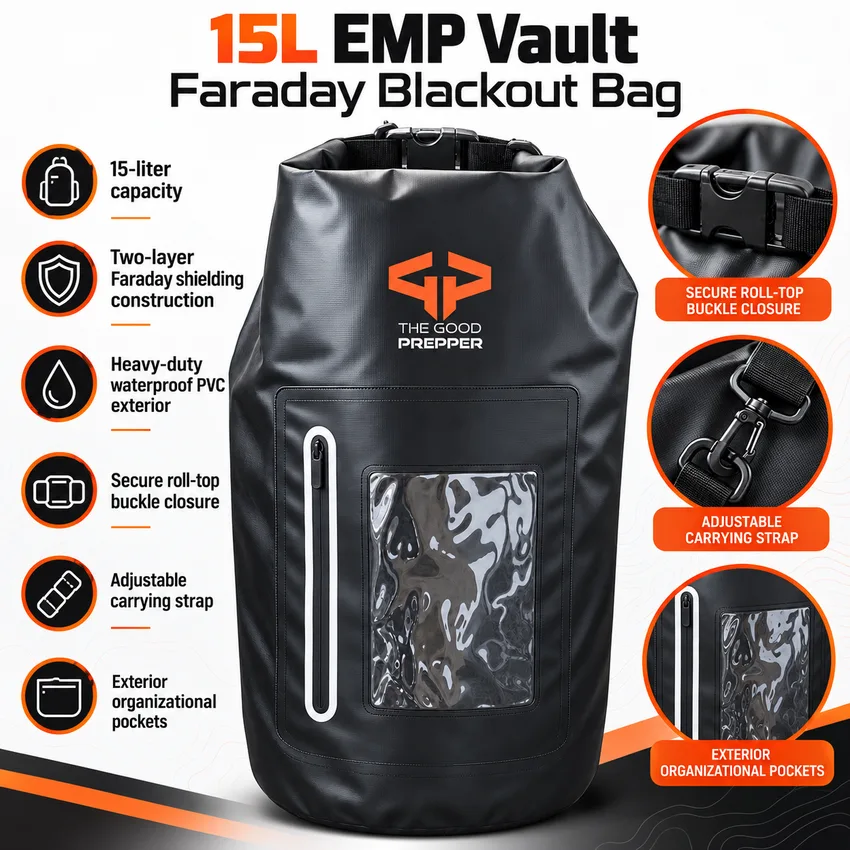
This is The Good Prepper EMP Vault.
It's a large, 15-liter Faraday Dry Bag designed for people who want to help shield their important portable electronics against electromagnetic interference while keeping them organized and ready for emergencies.
The inside contains specialized two-layer Faraday shielding material.
The outside is made from heavy-duty waterproof PVC.
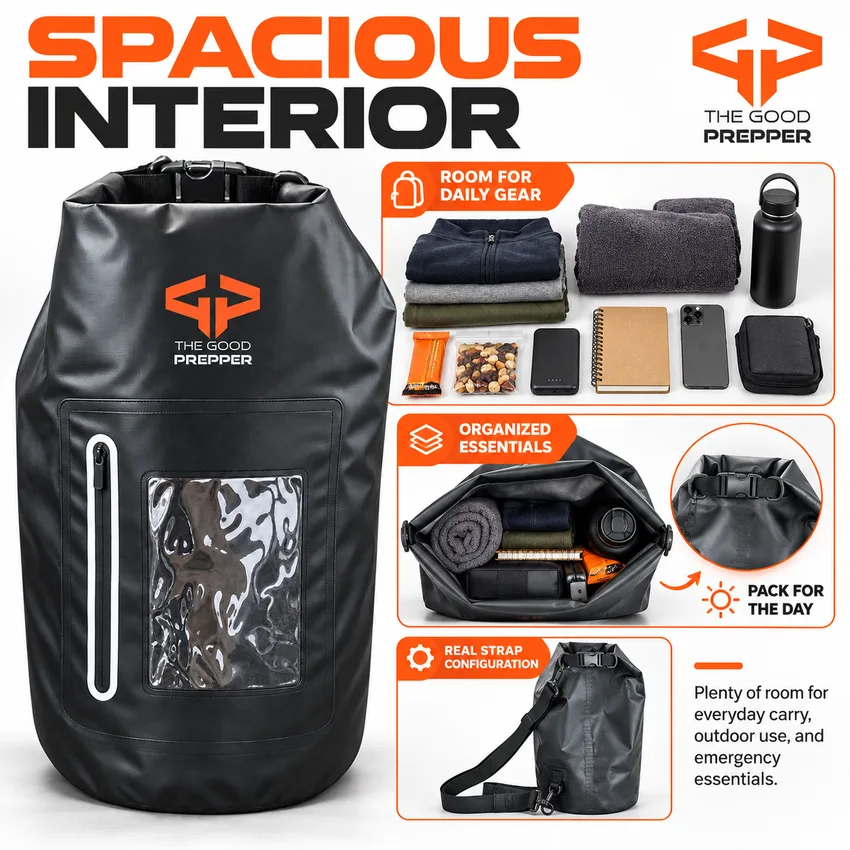
And unlike those tiny Faraday pouches that barely hold one smartphone, the EMP Vault is large enough to accommodate several compatible electronic devices.
Think of it as a dedicated protective storage space for the electronics you've been saving for an emergency.
You can put your radio inside.
Your spare phone.
Your laptop or tablet.
Your external hard drives.
Your power banks and compatible electronic accessories.
Then close the shielding compartment properly and keep the bag with your emergency supplies.
It doesn't require electricity to provide its shielding.
It doesn't need a subscription.
And you don't have to build anything.
The protection comes from the conductive shielding material surrounding the devices inside.
And here's something that makes this bag particularly useful.
It holds 15 liters.
That's substantially more than a conventional phone pouch.
Let me show you what that means.
Watch How Much You Can Fit
Inside the EMP Vault
Please take a look at the demonstration.
The EMP Vault stands approximately 21.5 inches tall, with a flat width of 14.6 inches and a bottom diameter of about 8.5 inches.
We've demonstrated that it can accommodate as many as four compatible laptops, depending on their dimensions.
Four laptops.
Now, I wouldn't necessarily recommend filling your entire bag with laptops.
I'd probably prefer a combination of useful emergency equipment.
For example, a portable radio, spare phone, small laptop, charging accessories, and power bank.
But the demonstration gives you a clear idea of how spacious the EMP Vault really is.
Instead of protecting only one device, you have room to organize a collection of equipment that may be important during an emergency.
And because everything is together, you know where it is.
That's especially useful when you're preparing for a situation where you may need to act quickly.
But the large capacity is only part of what makes this bag worth considering.
The real reason I'm showing it to you is what's inside.
Two Layers of Specialized Faraday Shielding
The EMP Vault uses two layers of shielding material designed to significantly reduce electromagnetic signals passing through its protective compartment.
The supplied shielding test specifications report attenuation greater than 100 dB across frequencies from 200 MHz to 40 GHz.
In ordinary language, that's a very substantial reduction in radio-frequency signal strength.
The bag is designed to isolate compatible portable devices from cellular, Wi-Fi, Bluetooth, and other radio-frequency signals when the main compartment is properly closed.
Faraday shielding is also an important way to reduce exposure to certain electromagnetic disturbances associated with EMP events.
And you can see the wireless isolation effect in a simple demonstration.
See What Happens When You Put a Phone Inside
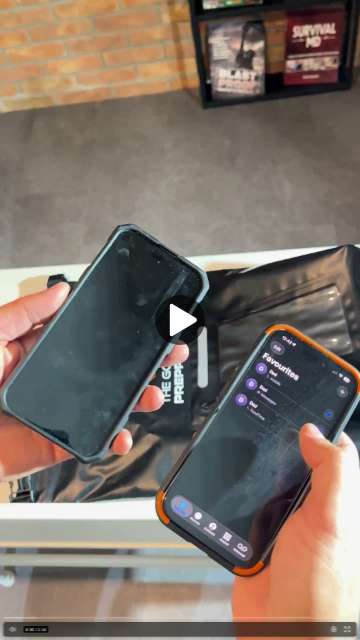
Take a working smartphone.
Place it inside the EMP Vault's shielding compartment.
Close the roll-top opening properly and secure the buckle.
Then try calling the phone from another device.
When the compartment successfully isolates cellular signals, the phone inside won't receive the incoming call.
You can conduct similar demonstrations involving other wireless connections.
And because this is something you can test for yourself, you don't have to rely only on a technical specification printed on a website.
I want you to be able to examine the bag and see its wireless isolation working.
Just remember that correct closure is important.
And while a phone test demonstrates radio-frequency isolation, it isn't the same thing as recreating a nuclear EMP.
What it does show is an important property of the protective shielding.
But protecting against electromagnetic interference isn't the only reason you might want an EMP Vault.
You Can Also Use It to Isolate Your
Electronics From Wireless Connections
There are times when you may want a particular device to stop exchanging wireless communications.
For example, you could place a spare smartphone inside the shielded compartment while it's in storage.
When the bag is properly closed and its shielding is functioning as intended, the phone is isolated from cellular and other wireless signals.
That means it won't receive ordinary calls or wireless updates while it's stored inside.
This is different from simply switching off Wi-Fi in the phone's settings.
You're using a physical shielding enclosure to isolate the device.
And when you want to use the phone normally, you can remove it.
It's a useful additional feature for people who are concerned about privacy or prefer to keep certain electronics disconnected when they're not in use.
The EMP Vault Also Has a
Tough Waterproof Exterior
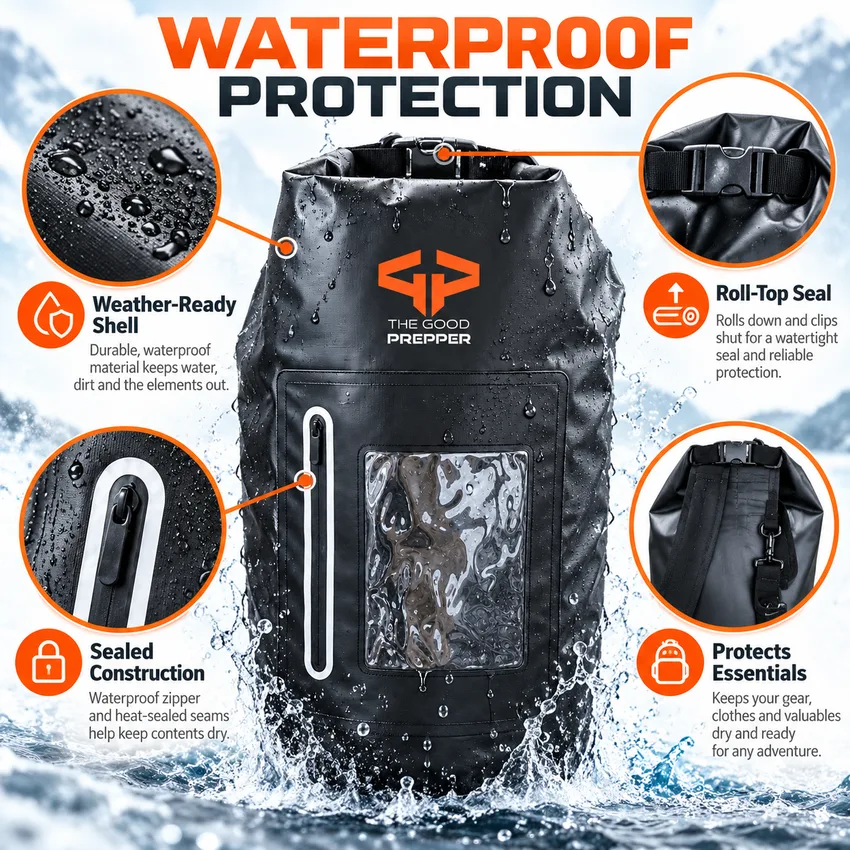
Here's another thing I like about the bag.
The outside is made from heavy-duty waterproof PVC.
That's important because emergency supplies aren't always stored in perfect conditions.
You may keep them in a garage, basement, vehicle, or other location where moisture can become a problem.
And if you're forced to move your emergency equipment in bad weather, having a waterproof exterior is a practical advantage.
The EMP Vault also has a roll-top closure with a secure buckle.
An adjustable shoulder strap.
Reinforced D-ring patches.
An exterior zippered pocket.
And a reflective strip.
The result is a bag you can store with your emergency equipment and carry when necessary.
You don't need a special cabinet or permanent installation.
You simply organize your compatible electronics, store them inside the shielding compartment, and close it as instructed.
There's also one small detail I think you'll appreciate.
Know What's Inside
Without Opening Your EMP Vault
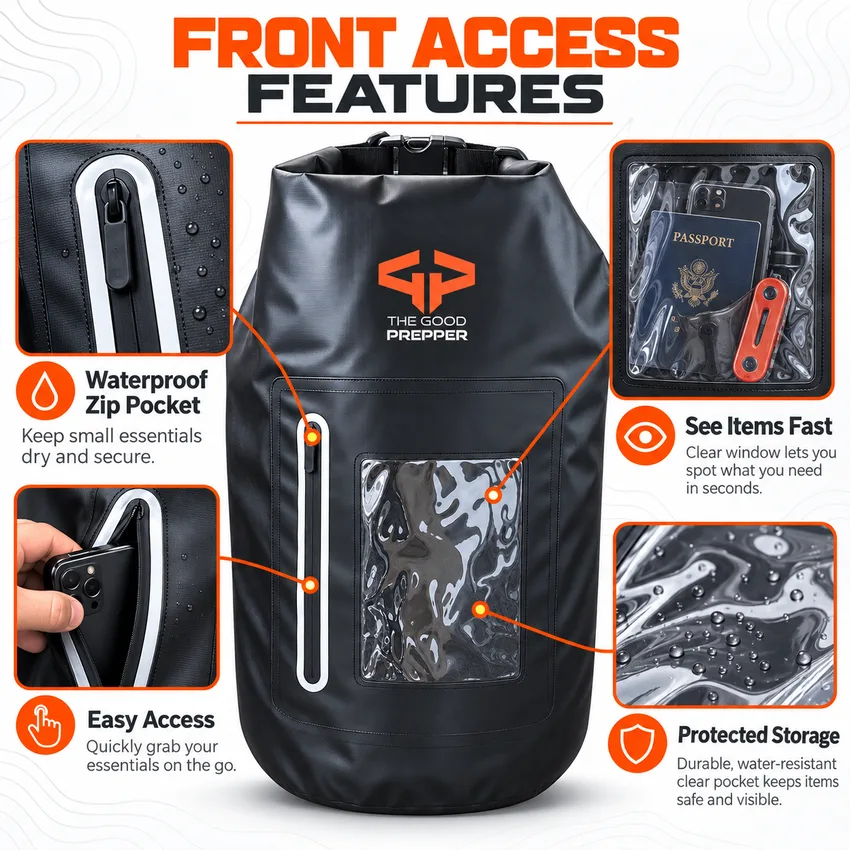
On the outside of the bag, you'll find a large transparent pocket.
It's approximately 6.7 by 9.4 inches.
And here's how I'd use it.
Write down everything stored inside the shielding compartment.
The radio.
The spare phone.
The laptop.
The power bank.
The charging cables and accessories.
Then slide that inventory into the transparent pocket.
Now you can see exactly what equipment you've stored without having to open the main compartment.
You could also use the pocket for a printed emergency checklist or equipment instructions.
The transparent exterior pocket itself isn't shielded, so electronics you want protected need to go inside the main compartment.
But for written instructions and inventories, it's a very useful feature.
Especially if you intend to leave your reserve electronics stored for long periods.
And speaking of reserves, there's another reason I believe you should consider getting more than one EMP Vault.
Why I Recommend Keeping Two EMP Vaults
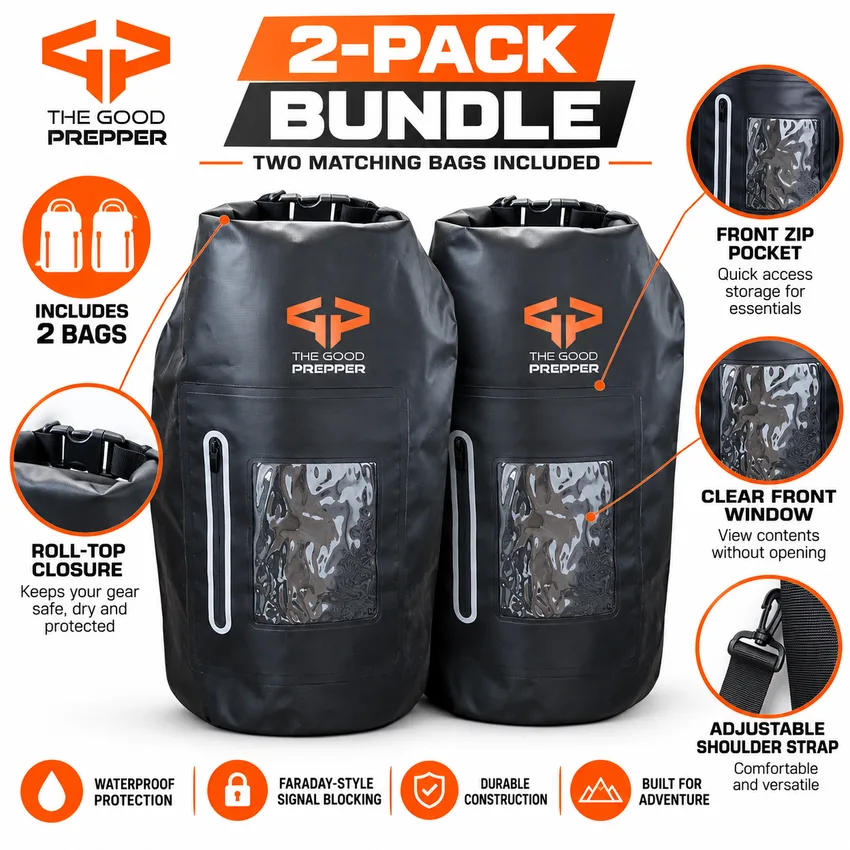
Why Some Families Choose TWO EMP Vaults Instead of One
For many families, one EMP Vault is all they need.
With 15 liters of space, it can hold your emergency radio, spare phone, laptop, power bank, and other important electronics in one protected place.
That's already a smart step toward being prepared.
But if you're thinking about getting a second EMP Vault, there's something I want you to consider.
If an EMP strikes, how will you know when it's safe to take your electronics out?
Think about it.
The power goes out. Your phone loses its signal. Nothing seems to be working.
Was it an EMP? How widespread was it? Could another pulse follow?
You may have no way of knowing.
Naturally, you'll want to check your emergency radio. Try to pick up a broadcast. Find out what's happening beyond your neighborhood.
But to do that, you'll have to open your Faraday bag.
And if every electronic device you've carefully protected is stored inside that same bag, you'll be opening the compartment that protects all of them just to retrieve one radio.
Wouldn't it be better to leave your most important backups protected while you check what's happening?
That's one of the biggest advantages of owning two EMP Vaults.
One for the electronics you're likely to reach for first.
Your emergency radio. A spare phone. Equipment you may need to check or use.
And another for the backups you'd rather leave untouched until you absolutely need them.
That way, you can take out what you need from the first bag without opening the second.
Your reserve electronics stay inside their shielded compartment while you assess the situation.
It's a small distinction now.
But in the middle of a serious emergency, having that choice could matter a great deal.
And What If You're Not Home When It Happens?
Most of us keep our emergency supplies in one place.
A basement. A garage. A closet.
But there's no guarantee you'll be home when disaster strikes.
You could be at work. Running errands. Or halfway across the state visiting family.
That's another reason some people prefer having two EMP Vaults.
One at home with their emergency supplies. Another in the vehicle, with a separate set of backup electronics.
Or perhaps you'd rather give the second one to someone you love.
An adult son or daughter who lives across town.
Your elderly parents.
A brother, sister, or close friend who may have to manage on their own if communications go down.
You can't guarantee you'll be able to reach them when something happens.
But you can help them prepare before it does.
And that's something I think every parent and grandparent can appreciate.
One EMP Vault gives you a protected place for your emergency electronics. Two give you more options for how — and where — you protect them.
Whether that means keeping your emergency reserves separate, preparing two different locations, or helping protect someone else in your family, the choice is yours.
And because I know many of you are preparing for more than just yourselves, I've arranged a special way to get a second EMP Vault for considerably less than buying two separately.
I'll explain exactly how that works in a moment.
But first, there's something important you need to know about how many EMP Vaults we actually have available.
I Don't Have an Unlimited Supply of EMP Vaults
I wish I had enough EMP Vaults for every person who might want one.
Unfortunately, our current inventory is limited.
We have only a small quantity available for this offer.
And because I don't know how quickly the remaining bags will sell, I can't promise they'll still be available if you decide to come back later.
I'm not going to tell you an exact number of hours until we run out.
I don't know that.
What I can tell you is that we have limited stock, and once the available inventory is sold, we won't be able to fill additional orders from this batch.
That's one reason I wanted to share the EMP Vault with you now.
And because I want you to get the most out of the electronics you protect, I'm including something extra with every order.
Actually, two special bonuses.
And I think you'll find them useful whether you order one EMP Vault or two.
Two FREE Emergency Preparedness Guides
— Included With Your EMP Vault

Protecting your emergency electronics is important.
But think about what happens after an EMP or a prolonged blackout.
You may have a working radio, but you'll still need a reliable way to keep it powered.
You may have equipment that survived, but the security systems around your house could be completely out of commission.
That's why I've decided to include two preparedness guides that address those problems.
These bonuses have a combined value of $68.
But when you order your EMP Vault today, you'll receive both of them absolutely FREE.
Unlimited Power
Five Cheap or Free Energy Sources for a Crisis
There's one problem with protecting your emergency electronics that I haven't mentioned yet.
Even if your radio or laptop survives an EMP, what happens when its battery runs out?
If the grid is down, you may not be able to plug your equipment into a wall outlet.
And if the blackout lasts longer than expected, simply having one fully charged power bank may not be enough.
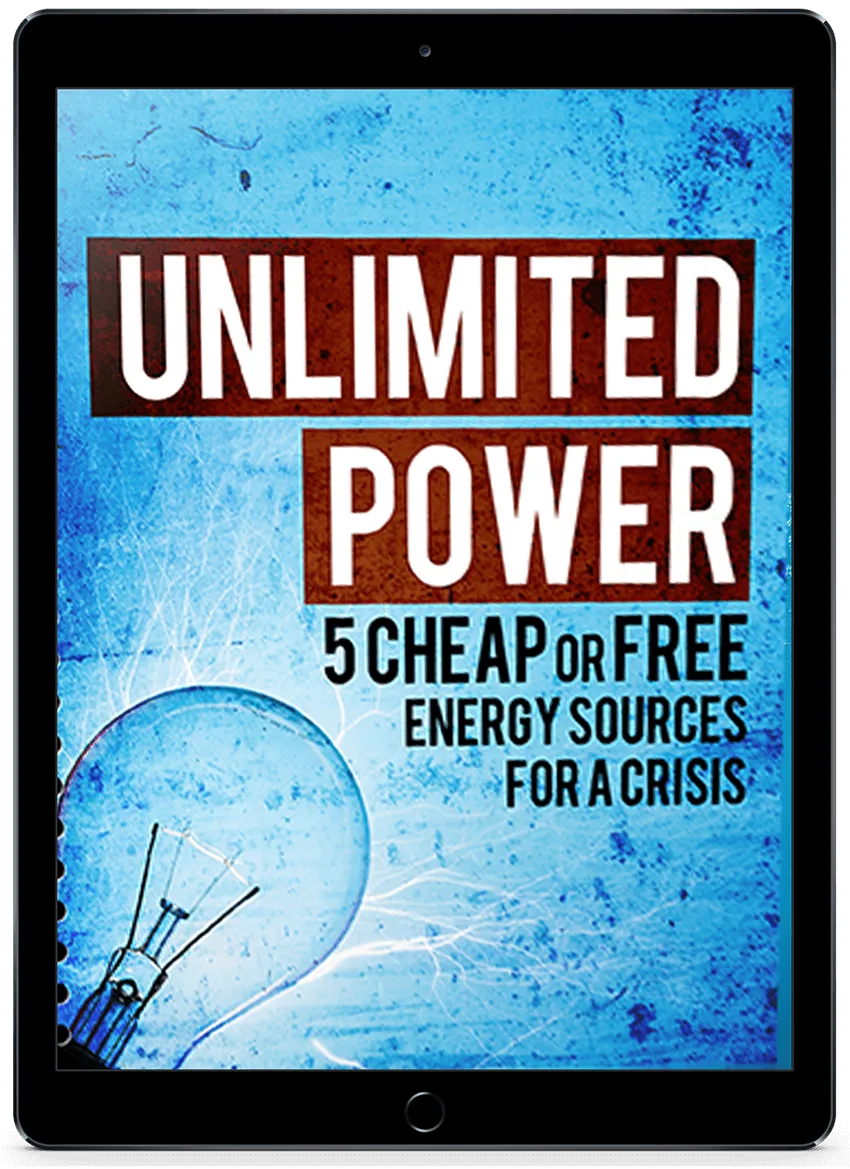
That's why I want you to have Unlimited Power: Five Cheap or Free Energy Sources for a Crisis.
This guide introduces five inexpensive or free energy sources you can investigate before a disaster.
It also explains practical setup considerations, so you're not trying to figure everything out while sitting in the dark.
Inside, you'll discover:
- Five cheap or free energy sources that may help provide electricity when the regular grid is unavailable.
- How to approach setting up each alternative before an emergency forces you to depend on it.
- Important precautions to consider when using alternative power sources.
- Ways to think beyond a single set of batteries when planning for a prolonged blackout.
Think about how these two things work together.
Your EMP Vault helps protect the electronic equipment you've set aside.
And Unlimited Power helps you plan for the electricity you may need to make that equipment useful afterward.
I consider that an important part of the same preparedness plan.
This digital guide has a stated value of $29.
But I'm including it at no additional charge with every EMP Vault order.
And that's just the first bonus.
Home Defense Blueprint
Protect Your Home When the Grid Goes Down
Here's something else worth thinking about.
A severe blackout could affect more than the lights and the appliances inside your home.
Your security cameras may stop working.
Your alarm system may become unreliable.
And if communications networks are down, getting immediate assistance could become much more difficult.
Meanwhile, your household still needs to be secure.
That's why the second bonus is Home Defense Blueprint.
It's a practical guide focused on making your home more difficult to target, especially when normal services and electronic security systems are unavailable.
Drawing on preparedness lessons associated with unstable and dangerous environments, this guide helps you think about household security before there's a crisis.
Inside, you'll discover:
- Practical ways to strengthen vulnerable areas of your home, including doors and entry points.
- How to make your property less attractive to opportunistic intruders.
- Why keeping valuable emergency supplies out of sight can be important.
- Ways to conceal sensitive supply storage, including water reserves.
- How to evaluate the role of a safe room in your overall home preparedness plan.
The EMP Vault helps protect important portable electronics.
But after a prolonged blackout, your family's safety will depend on much more than working devices.
You also need to think about the house itself.
And that's exactly why I've chosen this second bonus.
Home Defense Blueprint has a stated value of $39.
But it's yours FREE when you order your EMP Vault today.
That's $68 Worth of Preparedness Guides — FREE
You'll receive:
And you won't pay an extra cent for either guide.
Both are digital, so you can download them, read them on a compatible device, and print the pages you want to keep with your emergency supplies.
In fact, I encourage you to print the most important instructions while you still have electricity and a working printer.
The best time to learn these things is before the grid goes down.
Now, let me show you exactly what your complete EMP Vault package includes.
Here's How You Can Get Your EMP Vault Today
Option 1
ONE EMP VAULT + TWO FREE BONUSES
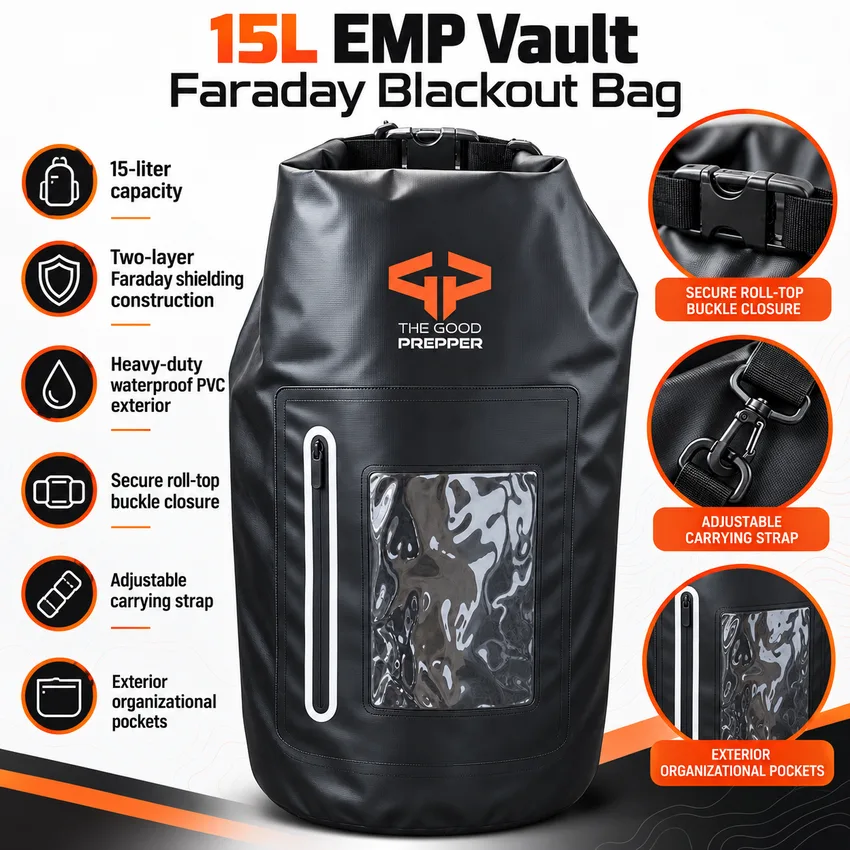
You receive one complete EMP Vault Faraday Blackout Bag.
Including:
- 15-liter capacity
- Two-layer Faraday shielding construction
- Heavy-duty waterproof PVC exterior
- Secure roll-top buckle closure
- Adjustable carrying strap
- Exterior organizational pockets
PLUS, you'll receive both digital guides:
FREE BONUS #1 — Unlimited Power ($29 Value)
FREE BONUS #2 — Home Defense Blueprint ($39 Value)
Here's the complete value of your package:
| What You Get | Value |
|---|---|
| One 15L EMP Vault | $59 |
| Unlimited Power — Digital Guide | $29 |
| Home Defense Blueprint — Digital Guide | $39 |
| TOTAL VALUE | $127 |
But you won't pay $127.
Your price today is just $59.
And for a limited time, SHIPPING IS FREE.
Plus, your purchase is backed by our 60-Day Money-Back Guarantee.


Option 2
TWO EMP VAULTS + TWO FREE BONUSES
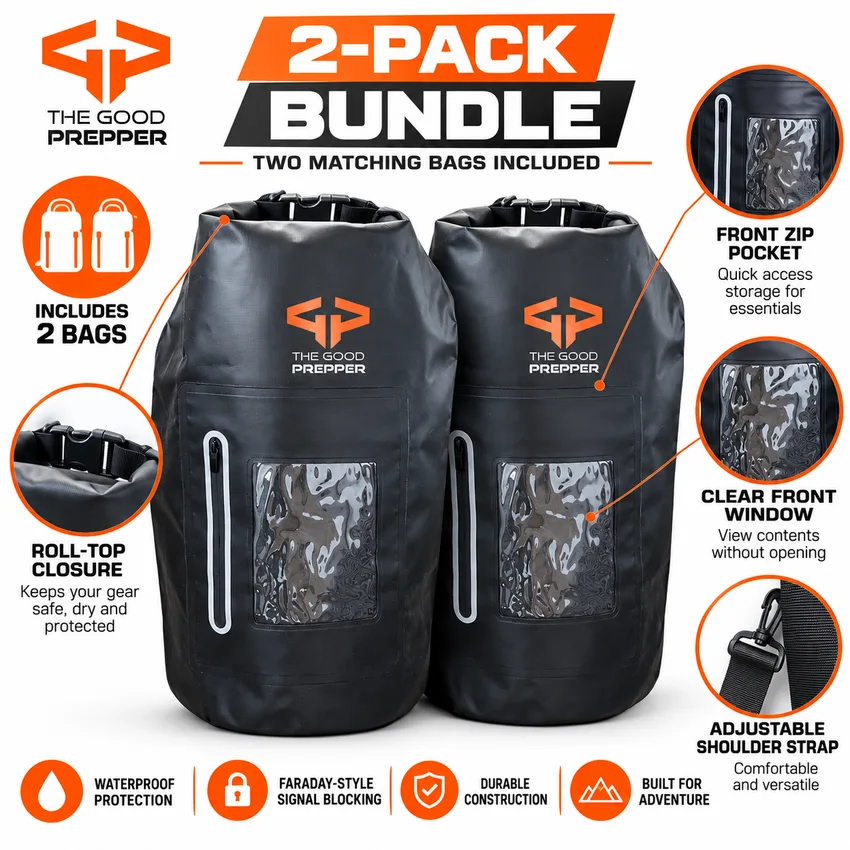
This is the package I'd recommend if you want to keep your ready-access electronics separate from your emergency reserves.
You receive TWO complete 15L EMP Vault Faraday Blackout Bags.
That gives you two spacious shielding compartments, two waterproof exteriors, and the flexibility to keep your emergency electronics organized in separate locations.
You'll also receive:
FREE BONUS #1 — Unlimited Power ($29 Value)
FREE BONUS #2 — Home Defense Blueprint ($39 Value)
Here's everything included:
| What You Get | Value |
|---|---|
| Two 15L EMP Vaults | $118 |
| Unlimited Power — Digital Guide | $29 |
| Home Defense Blueprint — Digital Guide | $39 |
| TOTAL VALUE | $186 |
But you won't pay $186.
You won't even pay the regular $118 price of the two bags.
Just $99 TOTAL
Today, you can get the complete two-bag package, including both free bonuses, for just $99 TOTAL.
That's $19 less than purchasing two EMP Vaults separately.
Or just $49.50 per bag.
And when you compare it to the single-bag package, you're getting the entire second EMP Vault for only $40 more.
You'll also receive FREE SHIPPING on both bags during our limited-time promotion.
And the entire purchase is protected by our 60-Day Money-Back Guarantee.
YES! SEND ME TWO EMP VAULTS + BOTH FREE BONUSES FOR JUST $99
Now, I want to point out something important.
Because our inventory is limited, every two-bag package uses two of the EMP Vaults we currently have available.
So if you've been planning to create two separate protected electronics kits, I'd encourage you to take advantage of the package while we can still fulfill it.
Of course, if one bag is all you need, the $59 package is an excellent way to start.
And remember, both packages include the same two free digital bonuses.
You're Protected by Our
60-Day Money-Back Guarantee

I understand that buying preparedness equipment online requires a certain amount of trust.
You want to know that the product is well made.
That it does what it's supposed to do.
And that you're receiving something useful for the money you're spending.
That's why your EMP Vault comes with our 60-Day Money-Back Guarantee.
When it arrives, take it out of the package.
Look at the heavy-duty exterior and shielding interior.
Try putting your own compatible electronics inside.
See just how much equipment it holds.
Then follow the instructions to properly close the bag and perform the wireless signal-blocking demonstration.
You have a full 60 days to decide whether you're satisfied.
And if you're not, contact our team within that period to request your money back.
That's the same guarantee whether you purchase one EMP Vault or two.
I want you to have the opportunity to inspect the bag for yourself and decide whether it deserves a place in your emergency supplies.
And in the meantime, you'll also have your two bonus guides to help you begin preparing for the challenges a prolonged blackout could bring.
Questions You May Have About the EMP Vault
Why You Should Get Your EMP Vault
While We Still Have Them
I want to leave you with one final thought.
When an emergency happens, the opportunity to prepare for it may already be gone.
You may not be able to order replacement electronics.
You may not be able to visit a store and buy another radio.
And if the power grid and communications networks are severely disrupted, you certainly shouldn't assume that the equipment you need will be easy to find.
That's why we prepare beforehand.
We store food while grocery stores are open.
We put aside water while it still comes out of the tap.
We buy emergency equipment while it's still available.
And we learn to use it before we're forced to depend on it.
Protecting your backup electronics should be part of that same preparation.
Because you may have already spent hundreds or even thousands of dollars on useful electronic equipment.
Radios, laptops, spare phones, power banks, and other devices.
Equipment you've purchased because you want to be ready if something goes wrong.
It makes sense to take precautions to help protect that investment.
Especially against a threat like an EMP, which could affect electronics at the same time it disrupts the systems around them.
That's exactly why I'm offering you the EMP Vault.
A spacious, portable Faraday Blackout Bag with two layers of specialized shielding, a waterproof exterior, and room for a collection of compatible emergency electronics.
And because surviving a blackout takes more than working electronics, I'm including two free preparedness guides to help you plan for the challenges that come afterward.
Unlimited Power will introduce you to five inexpensive or free sources of energy that may help you keep essential equipment running.
And Home Defense Blueprint will help you think through practical ways to protect your property when ordinary security systems and emergency services may be unavailable.
Together, these two digital guides have a stated value of $68.
But they're yours FREE with your EMP Vault order.
Here's what you can get right now:
ONE EMP Vault + Both Digital Bonuses — Just $59
TWO EMP Vaults + Both Digital Bonuses — Just $99
Both options include free shipping during our current promotion and our 60-day money-back guarantee.
But I want to remind you that we don't have an unlimited supply.
We have a limited number of EMP Vaults available right now.
And while I'd like to be able to help everyone who wants to prepare, I can't promise that these bags will still be in stock if you return to this page another day.
So if you believe your backup electronics deserve their own protected storage, I encourage you to take care of that now.
Choose the package that makes the most sense for your household.
Get your EMP Vault while it's available.
And give the electronics you've been counting on a better chance of being useful when you finally need them.
TWO EMP VAULTS
$99
+ Both FREE digital bonuses · Free shipping on both bags ·
60-day money-back guarantee
YES! SEND ME TWO EMP VAULTS + BOTH FREE BONUSES — $99
ONE EMP VAULT
$59
+ Both FREE digital bonuses · Free shipping · 60-day
money-back guarantee
YES! SEND ME ONE EMP VAULT + BOTH FREE BONUSES — $59